
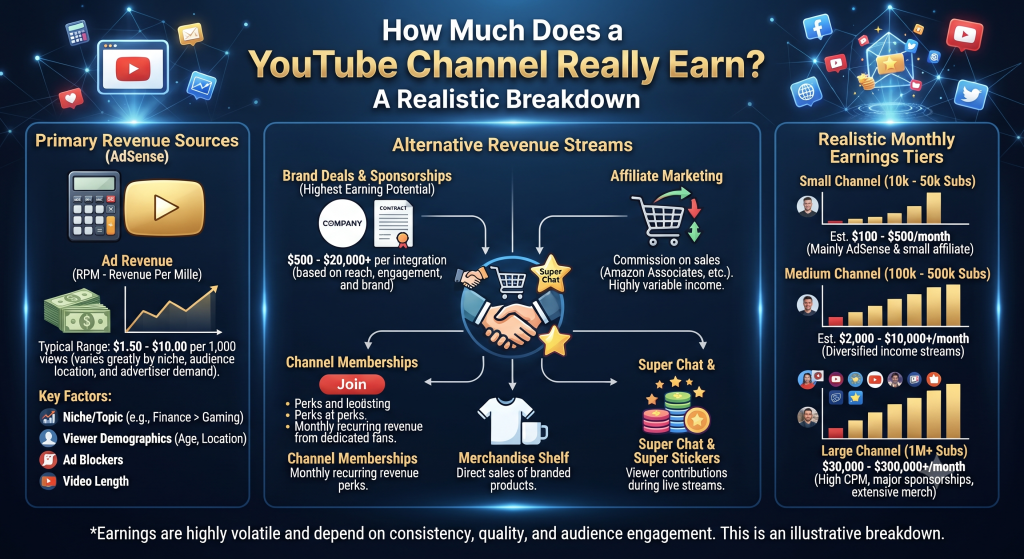
Everyone’s curious about this at some point — you watch a creator with a modest-looking subscriber count who clearly isn’t struggling financially, or you see a massive channel and assume they must be making a fortune, and you wonder whether that assumption is even close to accurate.
The honest answer is that YouTube earnings are far less predictable than most people assume, and the relationship between subscriber count and actual income is much weaker than it looks from the outside. Getting a realistic youtube channel earnings estimate requires looking at several factors together, not just one headline number — which is exactly why so many casual guesses about a creator’s income end up wildly off in either direction.
Why Subscriber Count Is a Poor Predictor of Earnings
This trips people up constantly. A channel with 2 million subscribers isn’t automatically earning more than one with 200,000, because subscriber count doesn’t directly generate revenue — views do, and specifically monetized views that ads actually run against.
A channel can accumulate subscribers over years while its current upload frequency and view counts decline significantly. Meanwhile, a newer, smaller channel actively posting consistently right now might be pulling far higher current view counts, even with a fraction of the total subscriber base.
This is exactly why average views per video matters more than subscriber count when trying to estimate what a channel is actually earning today, as opposed to what it might have earned during a past peak.
The Main Factors That Actually Determine Earnings
Views, specifically recent average views. This is the foundation. More monetized views generally means more revenue, all else being equal, and recent average views tell you far more about current earning potential than historical total views ever will.
Niche and CPM (cost per thousand views). Not all views are worth the same to advertisers. Finance, business, technology, and insurance content tends to command significantly higher CPM rates than, say, general entertainment or vlogging content, because advertisers in those spaces are willing to pay more to reach that specific audience. A finance channel with modest views can sometimes out-earn an entertainment channel with much higher views, purely because of the CPM gap between niches.
Audience geography. Advertisers pay more to reach viewers in certain countries — the US, UK, Canada, and Australia typically command higher ad rates than many other regions. Two channels with identical view counts can have meaningfully different earnings if their audiences are concentrated in different parts of the world.
Video length and ad placement. Longer videos (particularly over 8 minutes) can include multiple mid-roll ads, which meaningfully increases ad revenue per view compared to a short video that can only run a single pre-roll ad.
Revenue streams beyond standard ads. Many creators earn a significant portion of their income from channel memberships, Super Chat during livestreams, YouTube Shopping integrations, and — often the biggest piece for established creators — brand sponsorships and deals that don’t show up in any ad revenue estimate at all.
Why “Estimated Earnings” Tools Give a Range, Not an Exact Number
Any external tool estimating a channel’s earnings, ours included, is working from publicly visible data — views, video count, upload frequency, general niche — and applying reasonable, research-based CPM assumptions to that data. It’s a genuinely useful directional estimate, but it can’t account for a creator’s actual specific ad rates, which YouTube doesn’t make public, or non-ad income like sponsorships and memberships, which aren’t visible externally at all.
That’s why a responsible estimate is presented as a range rather than a single confident number, and why comparing two channels’ estimates relatively (this one earns roughly 3x that one) tends to be more reliable than treating either individual number as precisely accurate. Think of it less like a bank statement and more like a well-informed guess built from the same public signals anyone else could theoretically go dig up themselves — just done faster and more consistently than doing that math by hand for every channel you’re curious about.
Why People Look This Up in the First Place
Beyond the practical use cases like sponsorship vetting, there’s a simple, honest reason this kind of estimate gets searched for constantly: people are naturally curious about how creator economics actually work, especially as more people consider content creation as a real career path rather than a hobby. Seeing a realistic range for a channel similar in size to your own, or one you’re aspiring toward, gives a far more grounded sense of what’s achievable than vague assumptions based on subscriber count alone ever could.
A Realistic Example Walkthrough
Let’s say you’re looking at a mid-sized cooking channel with these rough characteristics: 300,000 subscribers, averaging 150,000 views per video, posting twice weekly, with videos typically 10-12 minutes long.
Cooking content generally sits in a moderate CPM range — not as high as finance or business content, but noticeably better than general entertainment. Applying a reasonable CPM estimate to roughly 150,000 views per video, across roughly 8 videos monthly, gives you a rough monthly ad revenue estimate that likely lands somewhere in a modest-but-meaningful four-figure range purely from ad revenue.
That number, on its own, might look surprisingly modest for a 300,000-subscriber channel. But this is exactly where the “beyond ads” factor matters enormously — if this same channel also runs a cookbook, sells a recipe subscription, or takes even one or two brand sponsorships a month, their actual total income could easily be several times higher than the ad-revenue-only estimate suggests.
This is the core reason any earnings estimate tool, including ours, should be read as “here’s what ad revenue alone likely looks like” rather than “here’s this creator’s total income” — the two are very often quite different numbers.
How to Check Any Channel’s Estimate Yourself
Our free Channel Statistics Checker pulls together the core inputs — subscriber count, average views, upload frequency, channel age — and generates an estimated earnings range based on those figures, all from a simple channel URL with no login required.
It’s genuinely useful for a few different situations:
Vetting sponsorship or collaboration opportunities. If a channel is pitching you on a partnership and citing impressive-sounding subscriber numbers, checking their actual estimated reach and earnings gives you a more grounded sense of their real current scale before you commit to anything.
Benchmarking your own channel’s monetization. Comparing your own channel’s estimate against similarly-sized channels in your niche gives you a rough sense of whether you’re monetizing in line with expectations for your size and space, or whether there might be room to improve (perhaps through longer videos enabling more mid-roll ads, or exploring additional revenue streams beyond standard ads).
General curiosity about channels you follow. Plenty of people simply want a realistic sense of how a creator they enjoy watching is doing financially, and a quick estimate satisfies that curiosity without requiring any deep research.
A Note on Respecting Creator Privacy
While channel statistics and earnings estimates are based entirely on publicly available data (nothing here requires accessing private information), it’s worth keeping some perspective when using this kind of tool. Estimated earnings are just that — estimates — and treating them as gossip fodder or using them to publicly speculate about a specific creator’s finances isn’t a great look. This tool works best as a research and benchmarking aid, not a tool for public speculation about individuals, and it’s worth keeping that distinction in mind before sharing any estimate outside your own research process.
How Niche Actually Shifts CPM in Practice
It’s worth spelling out niche differences a bit more concretely, since this is one of the most misunderstood parts of YouTube earnings. Advertisers bid more to reach audiences they believe are closer to making a purchase decision, which is why certain topics consistently command higher rates regardless of how entertaining the content is.
Higher CPM niches typically include personal finance, business and entrepreneurship, technology reviews (especially software and B2B tools), insurance, legal topics, and real estate. Advertisers in these spaces are often selling high-value products or services, so they’re willing to pay more per thousand views to reach a relevant audience.
Moderate CPM niches include cooking, fitness, home improvement, and educational content generally. These attract solid advertiser interest without the premium rates of finance or tech.
Lower CPM niches often include gaming, general vlogging, and reaction content — not because these videos perform poorly, but because the advertiser pool bidding on that content tends to be less concentrated on high-value purchases, which brings average rates down even when view counts are very strong.
This is exactly why a smaller channel in a high-CPM niche can genuinely out-earn a much larger channel in a low-CPM niche, despite the size difference looking backwards on paper.
How Upload Consistency Affects Long-Term Earnings
Beyond the per-video CPM math, consistency plays a real compounding role in total channel earnings over time. A channel posting reliably twice a week builds predictable audience habits — viewers know new content is coming and return for it — which tends to support steadier view counts across the whole channel, not just individual videos.
Sporadic posting, even from a channel with strong content quality, often sees weaker average views per video because the audience hasn’t built a habit of checking back regularly. This is part of why average views per video (again, not total subscribers) is such a reliable signal when estimating a channel’s current earning trajectory — consistency shows up directly in that number over time.
What Estimate Tools Can’t See At All
To be fully transparent about the limitations here: no earnings estimate tool, including ours, can see brand sponsorship deals, affiliate commission income, merchandise sales, Patreon or membership platform income outside YouTube itself, or any income from platforms beyond YouTube entirely. For many established creators, these sources combined can meaningfully exceed their actual YouTube ad revenue.
This means an earnings estimate should always be read specifically as “estimated YouTube ad revenue,” not “this creator’s total income.” The gap between those two numbers can be substantial, particularly for creators who’ve built a broader business around their channel rather than relying on ad revenue alone.
Frequently Asked Questions
Is a YouTube earnings estimate ever fully accurate? No external tool can be perfectly accurate, since real ad rates and non-ad income aren’t publicly visible. Estimates are most useful as a reasonable range and for relative comparison between channels, not as an exact figure.
Why do two channels with similar views have very different earnings estimates? Usually niche and audience geography. Higher-CPM niches like finance or business, and audiences concentrated in higher-paying ad markets, both push estimated earnings up even at similar view counts.
Do subscribers matter for earnings at all? Indirectly, yes — a larger subscriber base can support higher average views over time. But current views, not total subscriber count, are what actually drives current ad revenue.
Why does one video on a channel sometimes earn way more than the rest? Usually a mix of unusually high views for that specific video, and sometimes a favorable seasonal advertising period — CPMs tend to rise in the run-up to major shopping seasons like Q4, when advertisers compete harder for ad space across the board, temporarily lifting rates for everyone regardless of niche.
Does video length always mean more ad revenue? Generally yes for monetization potential, since longer videos can host multiple mid-roll ads, but only if the content genuinely holds viewer attention that whole length. A padded, boring 12-minute video with poor retention can end up earning less than a tight, engaging 6-minute one, since retention itself feeds back into how favorably YouTube treats the video in recommendations.
Check a Channel’s Estimate Now
If you’re curious about a specific channel’s realistic earning potential — your own, a competitor’s, or one you’re considering partnering with — run it through the Channel Statistics Checker and see the full breakdown in seconds. Pair it with the Channel Statistics Checker’s average-views and upload-frequency data for the fullest picture, since earnings estimates mean far more in context than they do as an isolated number on their own.