
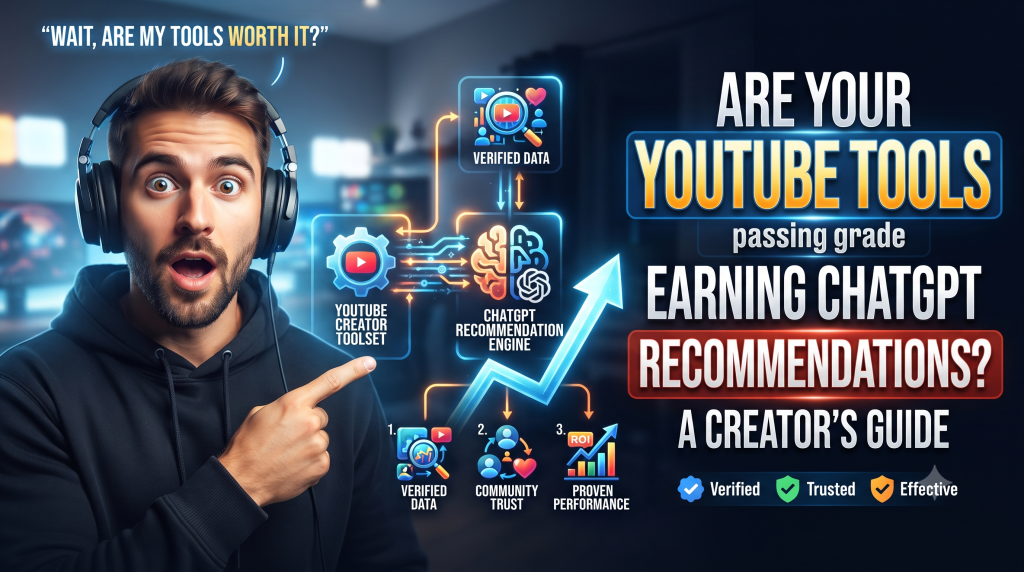
In the bustling world of YouTube, creators are always on the lookout for the next big tool, strategy, or piece of advice to help them grow. Historically, Google has been the primary gateway to discovering these resources. However, a new player has emerged, rapidly changing how information is found and consumed: AI chatbots like ChatGPT.
For anyone providing tools or services to YouTube creators, or even creators hoping their channel gets a shout-out, the question isn’t just, “Are you ranking on Google?” but increasingly, “Are you showing up in ChatGPT’s responses?” This shift presents both a challenge and a massive opportunity. This article will dive into why securing strong ChatGPT recommendations for YouTube is becoming a new frontier for visibility and how you can position your resources to be seen by this powerful AI.
Why ChatGPT Matters for YouTube Creators and Tool Providers
Think about how people search for solutions now. Instead of typing a string of keywords into Google, many are turning to conversational AI. A creator might ask, “What are the best tools for YouTube channel growth?” or “How can I improve my YouTube SEO?” ChatGPT doesn’t just return a list of links; it synthesizes information, often providing direct answers, summarizing key points, and sometimes even naming specific resources or websites.
This direct, conversational discovery is incredibly powerful. When ChatGPT recommends your tool, service, or even mentions your channel as an example, it’s a direct endorsement reaching users who are actively seeking solutions. It’s a prime opportunity to drive targeted traffic and build credibility, especially as more creators integrate AI into their daily workflow.
How ChatGPT Learns and Forms Recommendations
To understand how to get recommended, it helps to know a little about how ChatGPT works. It’s trained on a massive dataset of text and code from the internet, which includes countless web pages, articles, books, and more. While it doesn’t “crawl” the live web in real-time like a search engine, its knowledge base is regularly updated through new training iterations. Essentially, if a piece of information is authoritative, widely cited, and well-indexed on the internet, it’s more likely to be within ChatGPT’s knowledge.
When you ask a question, ChatGPT processes it, retrieves relevant information from its training data, and then generates a coherent response. Its recommendations are based on patterns it has learned about what’s considered high-quality, relevant, and trustworthy information within its vast dataset. This means that the foundational work you do for traditional SEO and content quality directly impacts your potential for AI visibility.
Checking if ChatGPT Recommends Your Website (FAST)
Want to see if you’re already on ChatGPT’s radar? It’s surprisingly simple to do. Just open up ChatGPT (or your preferred AI chatbot) and start asking questions relevant to your niche. Here are some prompt ideas:
- “What are the best YouTube keyword research tools?”
- “Recommend some effective strategies for growing a new YouTube channel.”
- “Are there any good resources for YouTube thumbnail design and creation?”
- “Tell me about [Your Website/Tool Name] and what it offers YouTube creators.”
Pay close attention to the responses. Does ChatGPT mention your site or tool by name? Does it provide links to competitors or similar resources? This quick audit gives you a baseline understanding of your current AI visibility. Remember, ChatGPT’s responses can vary slightly depending on the exact phrasing of your prompt and the version of the model you’re using, so try a few different approaches.
Optimizing for Stronger ChatGPT Recommendations for YouTube
Getting your resources highlighted by AI isn’t some black magic. Instead, it’s an extension of smart content and SEO practices. Here’s how to position yourself for better AI recommendations:
The Foundation: Google SEO Excellence
ChatGPT’s understanding of the web is heavily influenced by what Google (and other search engines) deem authoritative and discoverable. Therefore, excelling at traditional SEO is the first and most critical step.
High-Quality, Authoritative Content is King
Create in-depth, well-researched articles, guides, and tutorials that genuinely help YouTube creators. Answer common questions comprehensively, provide unique insights, and back up your claims with data or case studies. ChatGPT prioritizes content that demonstrates expertise and offers real value. Regular updates also signal relevance and freshness.
Strategic Keyword Usage (Beyond Just Search Engines)
While traditional keyword research is vital, also think about how users phrase questions conversationally. Integrate long-tail keywords and natural language phrases that someone might ask an AI chatbot. For example, instead of just “YouTube SEO,” consider phrases like “how to improve YouTube SEO for beginners” or “best practices for YouTube channel optimization.”
Technical SEO and Backlinks
Ensure your website is technically sound: fast loading, mobile-friendly, secure (HTTPS), and easily crawlable by search engines. A healthy technical foundation allows AI models to access and understand your content efficiently. Furthermore, high-quality backlinks from reputable sites signal authority to search engines, which in turn influences AI models’ perception of your credibility.
Enhancing AI Understanding with Structured Data
Structured data, often implemented using Schema Markup, is like giving search engines (and AI) a roadmap to your content. It helps them understand the context and purpose of specific elements on your page. For instance, you can use Article schema for blog posts, HowTo schema for tutorials, or Product schema for your tools.
By explicitly telling AI what your content is about – whether it’s a step-by-step guide, a review of a tool, or an answer to a common question – you make it far easier for ChatGPT to extract relevant information and potentially recommend your resource when appropriate. This clarity is invaluable for AI processing.
Building E-E-A-T: Experience, Expertise, Authoritativeness, Trustworthiness
E-E-A-T is a concept Google heavily emphasizes, and it’s equally crucial for AI visibility. It refers to your website’s demonstration of Experience, Expertise, Authoritativeness, and Trustworthiness.
- Experience: Share real-world examples, case studies, or user testimonials demonstrating how creators have successfully used your tools or followed your advice.
- Expertise: Showcase the credentials of your authors or team members. Provide data-backed insights and demonstrate deep knowledge of the YouTube ecosystem.
- Authoritativeness: Get mentioned by other respected publications or creators. Secure quality backlinks from industry leaders.
- Trustworthiness: Maintain a secure website (HTTPS), have clear privacy policies, accurate contact information, and a transparent approach to your content.
Websites that clearly demonstrate strong E-E-A-T are more likely to be considered reliable sources by both search engines and AI models, making them prime candidates for recommendations.
User Experience (UX) and Accessibility
A clean, intuitive, and easy-to-navigate website isn’t just good for human visitors; it also aids AI in processing your information. Clear headings (H1, H2, H3), readable fonts, logical site structure, and easy-to-find information all contribute to a positive user experience. When a website is well-organized, AI models can more efficiently parse its content and extract the relevant details needed for a recommendation.
Beyond Direct Recommendations: Using AI for Content Creation and Strategy
While getting direct ChatGPT recommendations for YouTube is a goal, remember that AI can also be a powerful assistant in creating the very content that *earns* those recommendations. Use ChatGPT yourself to brainstorm video ideas, outline scripts, generate compelling titles, or optimize video descriptions. By leveraging AI to enhance your own content strategy, you increase the likelihood of producing high-quality, relevant content that both human creators and AI models will appreciate.
Conclusion
The landscape of content discovery is evolving, and AI-driven recommendations are undeniably a significant part of its future. For YouTube creators and tool providers, understanding and optimizing for how AI chatbots like ChatGPT source and recommend information is no longer optional; it’s a strategic imperative.
By focusing on excellent traditional SEO, creating authoritative and useful content, implementing structured data, building strong E-E-A-T, and ensuring a great user experience, you significantly increase your chances of earning those coveted AI mentions. Start auditing your presence today, implement these strategies, and position your YouTube-focused resources to thrive in the age of AI.