
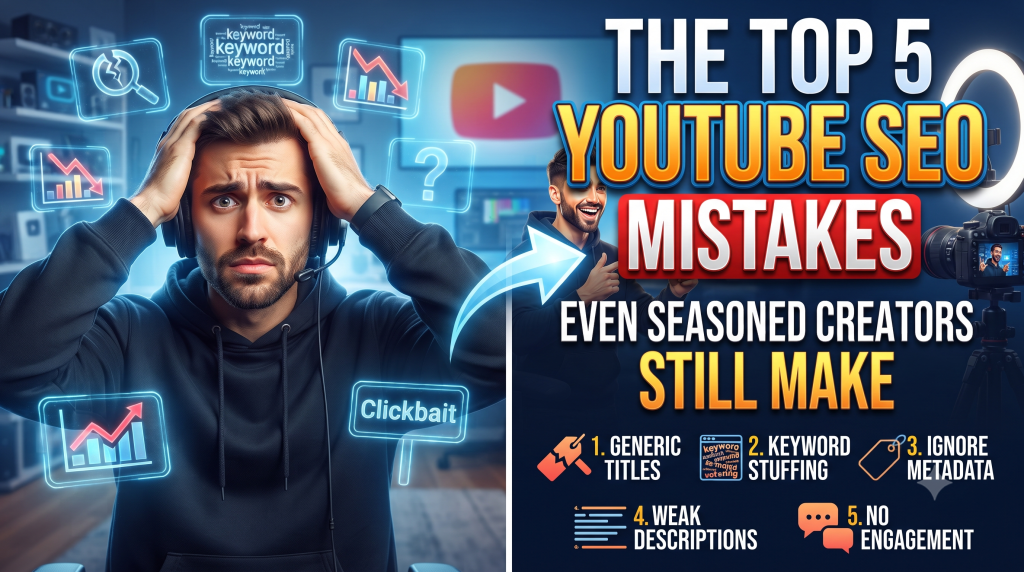
Even the most experienced video creators can fall into common traps when it comes to optimizing their content for YouTube. You’ve spent countless hours perfecting your visuals, honing your scripts, and delivering engaging performances. But if your videos aren’t reaching the right audience, all that effort might not be paying off as much as it should. Many seasoned creators, despite their expertise in video production, still make fundamental YouTube SEO mistakes that can significantly limit their channel’s growth and visibility.
It’s easy to assume that great content alone will naturally find its audience. However, YouTube is a colossal search engine, and understanding how it works is paramount to success. Ignoring the nuanced art of search engine optimization can leave your brilliant videos buried under a mountain of less-optimized, but more discoverable, content. This article will uncover the five most frequent YouTube SEO blunders even advanced creators commit, offering practical advice to help you fine-tune your strategy and ensure your content gets the attention it deserves.
Mistake 1: Skipping Thorough Keyword Research
One of the biggest oversights, even for channels with a solid subscriber base, is a lack of deep keyword research. It’s tempting to create content based purely on what you *think* your audience wants or what you enjoy making. While passion is crucial, failing to align it with what people are actually searching for on YouTube is a missed opportunity. Your audience uses specific terms and phrases to find solutions, entertainment, or information, and if you’re not speaking their language, they won’t find you.
Effective keyword research involves more than just guessing. Start by using YouTube’s search bar for suggestions, paying attention to auto-complete options and related searches. Tools like Google Keyword Planner, Ahrefs, or TubeBuddy can also provide valuable insights into search volume and competition. Furthermore, don’t forget to analyze your competitors. What keywords are they ranking for? Are there long-tail keywords – more specific, multi-word phrases – that you can target to attract a niche but highly engaged audience? Investing time here sets the foundation for all your subsequent SEO efforts.
Mistake 2: Underestimating Titles and Descriptions
Your video title and description are not just placeholders; they are critical pieces of your SEO puzzle. Many creators treat them as an afterthought, quickly jotting down something catchy without considering their full potential. This is a significant error, as these elements are the primary text signals YouTube’s algorithm uses to understand what your video is about and, consequently, who to show it to.
Crafting Compelling Titles
A strong title serves a dual purpose: it informs YouTube’s algorithm and entices human viewers to click. It should ideally include your primary keyword naturally, ideally near the beginning. However, don’t sacrifice clarity or intrigue for keyword stuffing. A good title is concise, accurately reflects your video’s content, and sparks curiosity. Think about what would make *you* click if you saw it in your feed. Use numbers, power words, and questions to make your titles stand out and clearly convey the value proposition of your video.
Maximizing Your Description Box
The description box is prime real estate for SEO. Yet, many creators use it sparingly or repetitively. Instead, view it as an opportunity to provide a rich, keyword-optimized summary of your video. Start with your main keyword in the first couple of sentences, then elaborate on what your video covers, incorporating secondary keywords naturally throughout. Include timestamps for different sections of your video, which not only helps viewers navigate but also provides more textual context for YouTube. Don’t forget to add relevant links to your website, social media, and related videos, along with a clear call to action.
Mistake 3: Neglecting Engagement Signals
YouTube’s algorithm doesn’t just look at keywords; it heavily prioritizes user engagement. Watch time, likes, comments, and shares are powerful signals that tell YouTube your content is valuable and resonating with viewers. Many seasoned creators focus so much on content production and initial optimization that they overlook the ongoing effort required to foster interaction.
If your videos aren’t generating significant engagement, it suggests to YouTube that your content might not be as relevant or captivating as others. Actively encourage interaction. Ask questions in your videos, prompt viewers to leave comments, and respond to those comments genuinely. Create content that naturally sparks discussion. High audience retention (how long viewers watch your video) is especially crucial, indicating your content is holding attention. Analyze your audience retention reports in YouTube Analytics to identify where viewers drop off and adjust your content strategy accordingly.
Mistake 4: Subpar Thumbnails and Weak Calls to Action
Even with perfect keyword optimization, your video won’t get views if people don’t click on it. Your thumbnail and calls to action (CTAs) are the visual and directive elements that bridge the gap between discovery and consumption. Many creators, despite producing high-quality video, often use generic thumbnails or forget to guide their viewers on what to do next.
The Power of a Clickable Thumbnail
Your thumbnail is your video’s billboard. It needs to be clear, compelling, and consistent with your brand. Avoid low-resolution images or confusing designs. Use contrasting colors, legible text overlays, and expressive faces to grab attention. A well-designed thumbnail should accurately represent your video’s content while also creating a sense of curiosity or urgency. Test different styles to see what resonates most with your target audience, as a strong thumbnail can dramatically increase your click-through rate (CTR).
Guiding Viewers with Clear CTAs
Once someone is watching your video, what do you want them to do? Subscribe? Watch another video? Visit your website? Many creators fail to explicitly state these actions. Integrate clear calls to action both verbally within your video and visually through end screens and cards. Don’t overwhelm viewers with too many options, but make it easy for them to take the next desired step. A well-placed and compelling CTA can significantly boost subscriber numbers, increase watch time across your channel, and drive traffic to other platforms.
Mistake 5: Ignoring YouTube Analytics for Iteration
Perhaps one of the most significant YouTube SEO mistakes any creator can make is to produce content, upload it, and then simply move on without reviewing its performance. YouTube Analytics is a goldmine of information, offering deep insights into how your videos are performing, who is watching them, and where they are coming from. Ignoring this data means you’re flying blind, missing crucial opportunities to learn and adapt your strategy.
Regularly dive into your analytics dashboard. Pay close attention to metrics like audience retention, traffic sources, demographics, and click-through rates. Which videos are performing best, and why? Where are viewers dropping off? Are your target demographics actually watching? Understanding these patterns allows you to refine your content topics, optimize your video structure, improve your titles and thumbnails, and ultimately create more of what your audience loves. Continuous learning and iteration, guided by data, are the hallmarks of a truly successful YouTube channel.
Mastering YouTube SEO is an ongoing journey, not a one-time task. Even for seasoned creators, it’s easy to overlook crucial optimization steps or fall into old habits. By actively avoiding these five common YouTube SEO mistakes – from insufficient keyword research to neglecting analytics – you can significantly boost your channel’s visibility, attract a larger and more engaged audience, and ensure your incredible content finally gets the recognition it deserves. Start implementing these changes today and watch your channel flourish.