
Ask five different creators how the YouTube algorithm works and you’ll get five different confident, contradictory answers. One swears by posting at exactly 3pm. Another insists the first hour of views determines everything. A third is convinced that hashtags are the secret. Most of this is folklore passed down from creator to creator, based on personal correlation rather than how the system actually functions.
The reality is both simpler and more demanding than most of the myths suggest. There isn’t one single algorithm — there are several different recommendation systems working across different parts of the platform, but they share a common underlying goal that, once you understand it, explains almost everything else, including why some tactics that sound reasonable on the surface simply don’t hold up in practice.
The One Goal Behind Everything
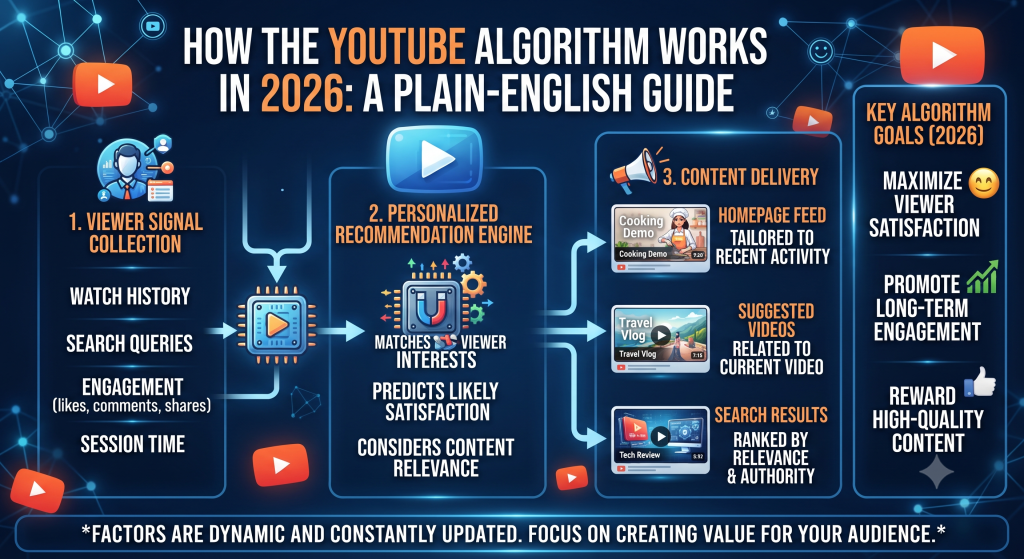
YouTube’s recommendation systems exist to maximize long-term viewer satisfaction and watch time on the platform. That’s it. That’s the entire underlying objective driving nearly every decision the algorithm makes.
Not your video’s satisfaction. Not fairness to creators. Not even short-term clicks, necessarily. The system is optimized to keep people watching YouTube, coming back to YouTube, and feeling good about the time they spend on YouTube, because that’s what keeps the platform valuable to advertisers and viewers alike over the long run, and ultimately what keeps the whole business sustainable enough to keep paying creators at all.
Every signal the algorithm weighs — click-through rate, watch time, retention, session duration afterward — exists because it’s a reasonable proxy for that one underlying goal. Understanding this single point clears up most of the confusion people have about specific tactics.
The Different Systems, Explained Simply
Search. When someone types a query into YouTube’s search bar, this system ranks videos based on relevance to that specific query, using title, description, tags, and — importantly — how well similar videos have historically satisfied viewers who searched that same term.
Suggested/recommended videos. This is the sidebar and “up next” system shown while or after watching a video. It leans heavily on topical similarity to what’s currently being watched, combined with what’s historically kept similar viewers engaged afterward.
Home feed. This is more personalized than search or suggested videos, drawing on a viewer’s entire watch history to predict what they’re likely to enjoy right now, blending familiar channels with some discovery of new ones.
Shorts feed. A more purely engagement-driven, rapid-fire recommendation system, optimized heavily around immediate watch-through behavior since Shorts are consumed so quickly compared to long-form content.
These systems overlap and interact, but they’re not identical, which is part of why a video can perform very differently across search versus suggested versus the Shorts feed — each system is asking a slightly different question about what a viewer wants right now, and a video optimized heavily for one context won’t automatically translate its performance to another.
The Signals That Actually Matter Most
Click-through rate (CTR). When your video is shown to someone — in search, suggested, or home feed — did they actually click it? A low CTR relative to similar videos being shown in the same context signals that your thumbnail and title aren’t compelling enough for the audience seeing them, and the algorithm will show it to fewer people as a result.
Average view duration and percentage watched. Once someone clicks, how much of the video do they actually watch? This is arguably the single most heavily weighted signal in the entire system, because it’s the most direct measure of whether the content actually delivered on its promise.
Session duration afterward. Did the viewer keep watching YouTube after your video ended, or did they close the app? Videos that lead into continued watching (whether that’s your own next video or someone else’s) are valued more highly than ones that cause viewers to leave the platform entirely, because that continued engagement serves YouTube’s core long-term watch time goal.
Engagement signals. Likes, comments, and shares provide additional context, though they’re generally considered secondary to watch time and retention rather than primary drivers on their own.
Why “The First Hour Determines Everything” Is an Oversimplification
This particular myth has some truth buried in it, which is exactly why it’s spread so widely. Early performance does influence how widely a video gets tested with additional audiences — a video that performs well with its first wave of viewers is more likely to get shown to a second, larger wave.
But “determines everything” overstates it considerably. YouTube continues testing and re-testing videos over time, particularly for search results, which are less dependent on that early momentum window than suggested/recommended placements are. Plenty of videos have found a second wind weeks or months after publishing, once they started ranking for a specific search term or got picked up by a wave of new suggested placements.
The practical takeaway isn’t “the first hour is everything or nothing” — it’s that early engagement genuinely helps, but a slow start doesn’t permanently doom a video, especially one targeting durable search terms rather than only depending on immediate viral momentum.
What Actually Moves the Needle in Practice
Given everything above, here’s where realistic effort pays off:
A thumbnail and title combination that earns genuine clicks from the right audience. Not clickbait that oversells and tanks retention afterward — a combination that’s honest but genuinely compelling to the specific people who’d actually enjoy the content.
A strong opening 15-30 seconds that doesn’t waste time. Long, slow intros are one of the most common retention killers. Getting to the actual value quickly matters enormously for the average view duration signal.
Content that matches what the title and thumbnail promised. Mismatch between promise and delivery tanks retention and, over time, damages how the algorithm treats your channel’s future uploads too.
Consistency over perfection. A channel posting reliably, even at a modest quality level, tends to build stronger long-term algorithmic trust and audience habit than one posting rarely but “perfectly.”
Common Algorithm Myths Worth Retiring
“Posting at a specific time of day matters enormously.” Posting when your specific audience is likely to be online has some logic to it, but it’s a minor factor compared to the actual content’s ability to earn clicks and hold attention. Obsessing over exact posting time while neglecting title and thumbnail quality is misplaced priority.
“Longer videos always perform better because of watch time.” Watch time in aggregate minutes matters less than percentage retention. A 20-minute video where viewers drop off at the 4-minute mark performs worse in the metrics that matter than a tight 6-minute video that holds attention to the end.
“The algorithm punishes you for taking a break from uploading.” There’s no evidence of an active punishment mechanic here. What actually happens is simpler: less recent content means less opportunity for the algorithm to test and recommend anything, and audience habits (checking back regularly) can fade during a long gap. That’s a natural consequence, not a deliberate penalty.
“Hashtags are a major ranking factor.” As covered in our tags guide, hashtags provide a small categorization signal, mainly useful for the first few shown above your title. They’re not a significant independent driver of algorithmic reach on their own.
How the Algorithm Treats New Channels Differently
A common worry among newer creators is that the algorithm is somehow biased against small channels, actively favoring established creators with existing subscriber bases. The reality is a bit more nuanced. YouTube does need some initial data before it can confidently recommend a video widely — without any watch history to learn from, the system genuinely doesn’t yet know who would enjoy your content, so it starts by testing your video with a small, cautious sample of viewers.
If that small sample responds well (decent CTR, strong retention), the system expands the test to a larger audience. If it doesn’t, distribution stays limited. This isn’t a bias against small channels specifically — it’s the same testing process applied to every single upload, from the newest channel to the largest, and it’s designed this way precisely so genuinely strong content from an unknown creator still has a real path to wider distribution. The difference is that established channels often benefit from an existing subscriber base who reliably show up for new uploads, which gives their videos an early data advantage in that initial testing phase. A new channel doesn’t have that built-in early audience yet, which is exactly why the first several videos on a channel often perform more modestly while that audience is still being built.
Why Some Videos Suddenly “Take Off” Weeks Later
This pattern confuses a lot of creators, but it’s a direct consequence of the testing-and-expanding system described above. A video might perform modestly in its first week, then suddenly see a significant traffic spike a month later with no new promotion behind it.
Usually what’s happened is one of two things: either the video started ranking for a specific search query that gained interest later (a seasonal topic, a product that just launched, a trend that picked up), or it got picked up as a suggested recommendation alongside a newer, more popular video covering a related topic. Neither of these requires the creator to do anything differently after publishing — it’s simply the algorithm continuing to test and place the video in new contexts over time, which is part of why patience with search-optimized evergreen content often pays off more than chasing only immediate viral spikes.
The Role of Viewer Feedback Signals
Beyond the core watch-time and CTR signals, YouTube also incorporates more direct feedback mechanisms into its recommendation decisions. Explicit signals like a viewer clicking “not interested” on a recommendation, or reporting a video, carry real weight — they’re a direct statement from a viewer about what they don’t want to see, which the system treats as meaningfully different from simply not clicking a video shown to them.
Positive explicit signals matter too, though somewhat less directly than the core watch-time metrics — comments in particular seem to serve as a secondary signal of genuine engagement, since leaving a comment requires more active effort than a passive like, and heavy comment activity often (though not always) correlates with strong viewer investment in the content.
Frequently Asked Questions
Does YouTube have one single algorithm? Not really — it’s a set of related recommendation systems (search, suggested videos, home feed, Shorts feed) that share the underlying goal of maximizing long-term viewer satisfaction and watch time, but weigh signals somewhat differently depending on context.
Does deleting and reposting a video help it perform better? No, and this can actually hurt you — you lose accumulated watch history, comments, and any existing search ranking the original video had built up. It’s rarely a good strategy compared to simply improving future uploads.
Is watch time in total minutes or percentage retention more important? Percentage retention (how much of the video relative to its length people actually watch) tends to matter more than raw total minutes, since it directly reflects whether the content held attention as promised.
Does the algorithm treat Shorts and long-form videos as competing for the same audience? Not exactly — they’re recommended through somewhat separate systems with different consumption patterns, so growth in one doesn’t necessarily cannibalize the other. Many channels successfully use Shorts to reach new viewers who then discover their long-form catalog separately.
Use This Understanding, Not Just Tactics
The specific tactics — better titles, stronger hooks, honest thumbnails — matter because of this underlying goal, not despite it. Once you understand what the system is actually trying to measure, it becomes much easier to evaluate any new “algorithm hack” you come across and separate genuine, sustainable strategy from folklore that happened to correlate with one lucky video rather than reflecting anything the system actually rewards consistently.
YouTube Keyword Research: A Step-by-Step Guide for Beginners