The first 1,000 subscribers are, by a wide margin, the hardest ones you’ll ever earn. Not because the content needs to be worse or better than what comes later — but because you’re starting with zero algorithmic trust, zero existing audience momentum, and zero of the compounding advantages that make growth easier once a channel has some traction behind it already.
This is exactly why so much generic advice about hitting 1,000 subscribers feels unsatisfying. “Just make good content consistently” is true, but it skips over the actual mechanics of how a channel with nothing goes from nothing to something.
Why the First 1,000 Are Genuinely Different
Every video you upload as a brand-new channel gets tested by YouTube’s algorithm with essentially no historical data to work from. The system doesn’t know who’d enjoy your content yet, because nobody has watched enough of it to establish that pattern. This means your early videos rely far more heavily on external discovery — search, being shared, existing personal networks — than on YouTube’s recommendation system doing much heavy lifting for you.
Once you cross into four or five figure subscriber territory, a returning audience that shows up reliably for new uploads starts doing real work for you, giving each new video an early engagement boost that a zero-subscriber channel simply doesn’t have access to yet. Understanding this difference matters because it changes what strategies actually make sense at the very beginning versus later on, once that compounding advantage starts to kick in.
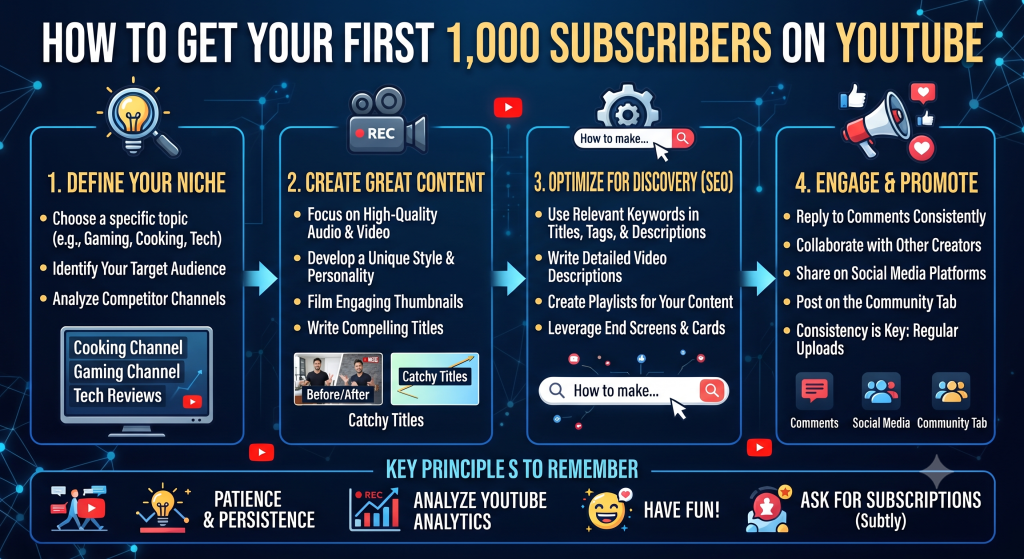
Pick a Specific, Winnable Niche — Not a Broad One
New creators often gravitate toward broad category descriptions — “I make lifestyle content” or “I do gaming videos” — which sounds appealing but puts you in direct competition with enormous, established channels covering the exact same broad territory.
A more specific, narrower angle gives you a realistic shot at actually being found. Instead of “gaming videos,” something like “speedrunning strategy breakdowns for [specific game]” targets a smaller but genuinely findable audience actively searching for that specific thing, where you’re not competing against every major gaming channel simultaneously.
This doesn’t mean staying narrow forever — plenty of successful channels broaden out significantly once they’ve built initial momentum. But starting specific gives your early videos a real chance to actually rank and get found, rather than disappearing into an ocean of broad, generic content.
Prioritize Search-Friendly Topics Over Trend-Chasing
Trending topics can bring a short-term spike, but they’re also the most competitive content on the platform at that exact moment, with every channel — including large established ones — piling onto the same trend simultaneously. A brand-new channel competing directly against that crowd rarely wins.
Evergreen, search-driven topics — the kind of specific “how to” or “why does” queries people search consistently over time regardless of trends — give a new channel a much more realistic path to actually being discovered, since you’re not trying to out-shout established creators in a trending topic’s crowded moment. Our guide on youtube keyword research walks through finding these specific, winnable search opportunities in more detail.
Nail Your First Few Seconds, Every Single Time
With no existing audience giving you the benefit of the doubt, every early video needs to earn attention immediately. A slow intro, a rambling setup before getting to the point, or a weak hook costs you viewers who have zero prior relationship with your channel and no reason to stick around through a slow start.
This matters disproportionately for new channels specifically, because established channels can occasionally get away with a slower opening since some portion of their audience already trusts them from past videos. A brand-new channel doesn’t have that cushion — the first 10-15 seconds need to work hard on every single upload.
Post Consistently, Even If It’s Not Daily
Consistency matters more than raw frequency in the early stages. A predictable schedule — even just once a week — gives YouTube’s algorithm regular new data points to test and learn from, and gives any early viewers a reason to expect and return for new content.
What actually hurts more than infrequent posting is unpredictable, sporadic posting — three videos in a week followed by a two-month gap, then another burst. This pattern makes it hard for both the algorithm and any early audience to build a habit around your channel. A realistic, sustainable schedule you can actually maintain long-term beats an ambitious schedule you abandon after three weeks.
Use Every Legitimate External Channel You Have
In the earliest stage, before YouTube’s own systems have enough data to help much, external promotion genuinely matters more than it will later. Sharing new uploads in relevant online communities (where self-promotion is actually welcomed, not just tolerated), on other social platforms where you might already have some following, or with any existing personal or professional network gives your first videos a real audience beyond pure organic discovery.
This isn’t a permanent strategy — as your channel grows, organic discovery through search and recommendations should increasingly take over. But in the first weeks and months, this kind of active, deliberate outreach often makes the difference between a video sitting at 12 views and one that actually gets enough initial traction for YouTube’s systems to start testing it more widely.
Study What’s Actually Working in Your Specific Niche
Rather than relying purely on generic advice, look directly at smaller and mid-sized channels succeeding in your specific niche right now. Checking their actual stats — average views per video, upload frequency, channel age — through our Channel Statistics Checker gives you a realistic, current benchmark for what growth actually looks like in your specific space, rather than comparing yourself to massive channels in completely different niches with years of head start.
This also helps set realistic expectations. If successful channels in your niche typically took 8-12 months to reach 1,000 subscribers, that’s useful, grounding context — a far healthier benchmark than assuming something’s wrong if you haven’t matched a completely unrelated viral creator’s trajectory within your first few weeks.
Optimize the Fundamentals on Every Upload
None of the strategic advice above matters much if the basic discoverability fundamentals are weak. Every video should have a clear, specific title with a real keyword, a description that opens with genuine context rather than generic filler, and a thumbnail that’s sharp and compelling even at a small display size. Our SEO Analyzer, Title & Description Generator, and Thumbnail Downloader exist specifically to help get these fundamentals right without requiring hours of manual work on every single upload.
What NOT to Do While Building Toward 1,000
Don’t buy subscribers or engagement. Beyond violating YouTube’s terms of service and risking real penalties to your channel, purchased subscribers don’t watch your videos, which actively hurts your average engagement metrics and can make your channel look worse to the algorithm, not better.
Don’t delete and re-upload videos that didn’t perform well. This resets accumulated watch history and any search ranking progress the original had. It’s almost always better to improve your next video than to erase evidence of the learning process behind you.
Don’t obsess over subscriber count itself over average views. A channel with 800 subscribers and consistently strong average views per video is in a genuinely healthier position than one with 1,200 subscribers and declining recent view counts. The number itself matters less than the underlying trend.
Collaborating Even at a Small Scale
Collaboration is often framed as something only established creators can do, but small-scale collaboration between similarly-sized new channels is genuinely accessible and can meaningfully help both sides. Two channels with 200 subscribers each, covering related but not identical topics, can cross-promote to each other’s audiences in a way that benefits both without either side needing any real leverage or negotiating power.
This works best when the audiences genuinely overlap in interest but aren’t identical — a beginner cooking channel and a kitchen equipment review channel share an audience without directly competing for the same specific content. Reaching out directly and proposing something concrete and low-effort (a shoutout in a video description, a brief mention, a simple joint video idea) tends to work far better than a vague “let’s collab sometime” message with no specific plan attached.
Engaging With Your Actual Early Viewers
In the earliest stage, every single comment and interaction matters more than it will once a channel has scale. Replying to comments, especially thoughtfully rather than with a generic “thanks for watching,” turns casual early viewers into a genuinely invested small community who feel some real connection to the channel’s growth.
This doesn’t scale forever — a channel with thousands of comments per video can’t reply to everyone the way one with fifteen comments can. But in the early stage, this kind of direct engagement is both feasible and disproportionately valuable, since those same early, engaged viewers are often the ones who share your content further, return reliably for new uploads, and provide genuinely useful feedback about what’s resonating and what isn’t.
Being Honest About What “Consistency” Actually Requires
It’s worth being upfront that consistent posting is harder to sustain than it sounds, especially while a channel is still small and the payoff feels distant. Burnout is a real, common reason promising channels stop before they ever reach real momentum, and it’s worth building a genuinely sustainable schedule from the start rather than an aggressive one that looks impressive on paper but isn’t realistic to maintain for months on end.
A sustainable weekly upload maintained consistently for a year will almost always outperform an ambitious daily schedule that collapses after three weeks, purely because consistency compounds and gaps reset momentum. If you’re unsure what’s sustainable, it’s better to start conservative and increase frequency later once a workflow is genuinely comfortable, rather than starting aggressive and burning out before the algorithm and audience have had a real chance to respond.
Frequently Asked Questions
How long does it realistically take to reach 1,000 subscribers? It varies enormously by niche, consistency, and content quality, but many successful channels take somewhere in the range of 6 months to a year of consistent uploading. Channels in highly specific, search-friendly niches sometimes move faster; broad, highly competitive niches often take longer.
Does posting Shorts help reach 1,000 subscribers faster than long-form video alone? Shorts can meaningfully accelerate discovery, since they’re recommended through a somewhat separate, high-volume system that can expose your channel to entirely new viewers quickly. Many channels use Shorts specifically to drive discovery, then convert some of those new viewers into long-form subscribers.
Is it bad if growth feels slow at first? No — slow early growth is the normal, typical pattern for the vast majority of channels, not a sign something is fundamentally wrong. The channels that eventually break through are usually the ones that kept posting consistently through this exact slow early period rather than stopping.
Should I focus on one platform first, or build presence everywhere at once? For most new creators, focusing primary effort on YouTube itself while using other platforms mainly to redirect existing followers toward your channel tends to work better than spreading thin trying to build multiple platforms from zero simultaneously.
The Honest Bottom Line
There’s no single trick that reliably skips past the early, slow-growth phase most channels go through. What actually works is a combination of realistic niche selection, consistent posting, genuinely strong fundamentals on every upload, and enough patience to keep going through a period that can legitimately take months to show real momentum. The channels that get past 1,000 subscribers are, more often than not, simply the ones that kept showing up consistently while steadily improving the basics along the way, rather than the ones that found some hidden shortcut everyone else missed.