
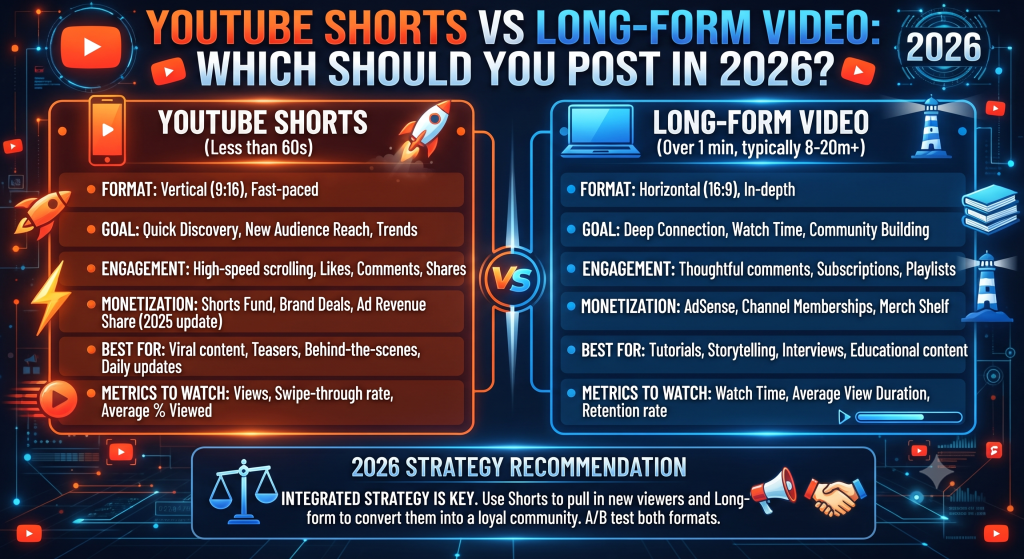
Every new creator eventually hits this fork in the road: spend your limited time and energy on Shorts, on long-form video, or try to split effort across both? There’s no single universally correct answer, but there is a genuinely useful framework for figuring out what’s right for your specific situation, rather than just guessing or copying whatever format a random successful creator happens to be using right now.
What Shorts and Long-Form Actually Do Differently
Shorts are primarily a discovery engine. They’re recommended through a high-volume, rapid-fire feed that can put your content in front of viewers who have zero prior relationship with your channel, at a scale long-form video rarely matches for a small or new creator. A single Short can reach far more new eyeballs than a typical long-form video from the same channel, especially early on in a channel’s life before any real audience base exists.
Long-form video is primarily a depth and monetization engine. It supports much stronger ad revenue per view (multiple mid-roll ads on longer videos versus limited monetization on Shorts), builds deeper viewer relationships through longer watch sessions, and tends to convert casual viewers into genuinely loyal subscribers more effectively than a quick 30-second clip typically can on its own.
Neither format is objectively superior — they’re built for different jobs. The real question is which job matters more for your specific channel goals right now.
When Shorts Make More Sense to Prioritize
You’re starting from zero or near-zero. New channels benefit enormously from Shorts’ discovery reach, since long-form content on a brand-new channel struggles to get much algorithmic distribution without any existing viewer history to learn from. Shorts can put your channel in front of real people faster.
Your content naturally breaks into quick, self-contained moments. Quick tips, single jokes, fast tutorials, or striking visual moments translate naturally to a 30-60 second format without feeling forced, artificially compressed, or stretched thin to hit a longer runtime.
You have limited production time. Shorts generally take less time to produce than a polished long-form video, making them a more sustainable option if you’re balancing content creation against a full-time job or other major commitments.
You want to test topic ideas cheaply before committing to a full long-form video. A Short performing unexpectedly well on a specific topic is a strong signal that a deeper long-form video on the same subject might also resonate well with your audience.
When Long-Form Makes More Sense to Prioritize
Your content requires genuine depth. Tutorials with multiple steps, in-depth reviews, storytelling that needs room to breathe, or educational content covering nuanced material generally doesn’t compress well into a 60-second format without losing what made it valuable.
Monetization is a primary goal right now. Long-form video’s ability to host multiple mid-roll ads on longer content generally produces meaningfully stronger ad revenue per view than Shorts currently offer, making it the stronger choice if near-term income is a priority.
You’re trying to build a deeply loyal, returning audience rather than just raw reach. Long-form viewers who stick around for 10-20 minutes tend to develop a stronger relationship with a creator than someone who watched one 30-second clip and scrolled on immediately after.
Your niche is inherently more suited to sustained attention. Certain topics — detailed finance breakdowns, in-depth documentary-style content, long-form interviews — simply don’t work as well chopped into short clips without losing the substance and nuance that makes them valuable in the first place.
The Case for Doing Both (Strategically, Not Randomly)
Plenty of successful channels use both formats deliberately, with each serving its natural strength rather than treating them as interchangeable content types. A common, genuinely effective approach: use Shorts primarily for discovery, pulling in new viewers who’ve never encountered your channel before, then rely on long-form content to convert some portion of those new viewers into genuinely engaged subscribers who stick around.
This might look like posting a Short covering one specific, punchy moment or tip, with the description or a closing frame pointing toward a related, more in-depth long-form video on the same broader topic for viewers who want more. Done well, this creates a genuine funnel rather than two disconnected content streams competing for the same limited production time.
The key word here is deliberately. Randomly alternating between formats without a clear strategy behind the mix tends to underperform compared to either committing fully to one format or building a genuine, intentional connection between the two.
A Realistic Time-Budget Consideration
It’s worth being honest about a factor that generic advice often glosses over: production time is finite, and splitting effort across both formats means less total time available for either one individually. For a creator working alone with limited hours per week, trying to produce high-quality content in both formats simultaneously often results in mediocre output in both, rather than excellent output in either.
If you’re genuinely time-constrained, it’s often more effective to commit primarily to one format, build real competency and a real audience there first, and only expand into the second format once the first is running smoothly and sustainably — rather than spreading thin across both from day one and struggling to maintain quality or consistency in either one.
Does Posting Shorts Hurt Your Long-Form Channel’s Algorithm Standing?
This is a common worry, and the reasonable answer is: not directly, though it’s worth understanding the nuance. Shorts and long-form video are recommended through somewhat separate systems with different consumption patterns, so strong Shorts performance doesn’t directly boost or hurt your long-form video’s individual algorithmic treatment, and vice versa.
What can happen is an indirect effect: if Shorts bring in a large volume of new subscribers who primarily came for quick, casual content and have little genuine interest in your long-form uploads, your long-form average view duration and retention metrics on new viewers might look weaker simply because a portion of your subscriber base isn’t actually your target audience for that format. This isn’t really “Shorts hurting your channel” so much as a reminder that not every subscriber gained through one format will necessarily engage equally with content in the other.
A Practical Decision Framework
If you’re still unsure which to prioritize, these questions tend to clarify things quickly:
Is your primary current goal reach and discovery, or deeper audience relationship and monetization? Shorts leans toward the former, long-form toward the latter.
Does your specific content genuinely need more than 60 seconds to deliver its actual value? If yes, forcing it into Shorts format likely weakens it. If your content is naturally quick and punchy, forcing it into a padded 10-minute long-form video likely weakens it in the opposite direction.
How much genuine production time do you realistically have per week? Be honest here rather than aspirational — a sustainable single-format commitment beats an ambitious dual-format plan that collapses under real time constraints within a few weeks.
How Audience Expectations Differ Between the Two Formats
Viewers arrive at Shorts and long-form video with genuinely different mindsets, and content that ignores this distinction tends to underperform regardless of quality. Someone scrolling the Shorts feed is typically in a fast, low-commitment browsing mode, making split-second decisions about whether to keep watching or swipe away almost instantly. There’s little patience for a slow build or lengthy setup — the value needs to land almost immediately.
Someone clicking into a long-form video, by contrast, has already made a more deliberate choice to invest several minutes of attention, which allows for a slightly slower build, more context-setting, and a more layered structure than a Short could ever support. Trying to apply Shorts-style pacing to a 15-minute video can feel exhausting and gimmicky over that length, while trying to apply long-form pacing to a Short will lose viewers within the first couple of seconds. Recognizing which mindset your specific content and format combination is working with helps avoid mismatched pacing that undermines otherwise strong content.
Repurposing Between Formats the Right Way
A common, genuinely efficient strategy is repurposing long-form content into Shorts rather than treating the two formats as requiring entirely separate content pipelines. A single well-produced long-form video often contains several standalone moments — a strong point made concisely, a surprising reveal, a punchy piece of advice — that can be extracted and reformatted as individual Shorts without needing to film anything new.
The key to doing this well is genuine editing, not just trimming. A raw 45-second clip pulled directly from a longer video often lacks the immediate hook a standalone Short needs, since it was originally filmed with the surrounding context of a longer piece in mind. Adding a punchier opening line, tightening pacing, or reframing the clip slightly for standalone viewing usually produces a meaningfully stronger result than a straight, unedited excerpt.
This repurposing approach also solves the production-time tension covered earlier to some degree — you’re not creating two completely separate content pipelines from scratch, but rather getting additional discovery-focused content out of work you were already doing for your primary long-form uploads.
Watching the Metrics That Actually Reflect Success in Each Format
It’s worth pointing out that “success” looks different across the two formats, and judging both by the same yardstick leads to misleading conclusions. A Short with 50,000 views but only a 15% average completion rate might still be doing its discovery job well if it’s driving meaningful channel page visits and subscriber growth, even though that completion rate would be considered weak for a long-form video, where retention is judged very differently and generally needs to be much higher to be considered strong.
Comparing a Short’s view count directly against a long-form video’s view count as if they mean the same thing is a common but flawed instinct — the two numbers reflect genuinely different audience behaviors and shouldn’t be evaluated on identical terms. Looking at each format’s own relevant success metrics separately — completion rate and shares for Shorts, average view duration and session continuation for long-form — gives a much more accurate read on whether either is actually working for your specific goals.
Frequently Asked Questions
Can a channel succeed with Shorts alone, without any long-form content? Yes, plenty of channels build substantial audiences purely on Shorts. Whether that’s the right choice depends on your content style and goals — particularly around monetization, since Shorts revenue per view is generally lower than long-form.
Should a brand-new channel start with Shorts or long-form first? Shorts generally offer a faster path to initial discovery for a channel with zero existing audience, since long-form content on a brand-new channel often struggles for early algorithmic distribution without any viewer history to draw on.
Do Shorts and long-form videos compete against each other in search results? Not directly — they’re generally surfaced through different systems and often shown in different contexts (a dedicated Shorts feed versus standard search and suggested video placements), so they’re not typically competing head-to-head for the same specific search query results.
Is it better to repurpose long-form content into Shorts, or create Shorts independently? Both have a place. Repurposing is more time-efficient and works well when your long-form content naturally contains standalone moments. Independently created Shorts allow more format-specific creativity but require separate production time and planning.
Choose Based on Your Actual Goals, Not Generic Advice
There’s no universally correct answer to Shorts versus long-form — the right choice depends entirely on your content type, your available production time, and whether reach or deeper monetized engagement matters more to you right now. Being honest about these specifics, rather than copying whatever format a completely different creator in a completely different niche happens to be using, leads to a far more sustainable and effective content strategy over the long run.
You can Visit Our Website for more tools. Click Here
Unlock Your Channel’s Potential: Mastering AI for YouTube SEO