
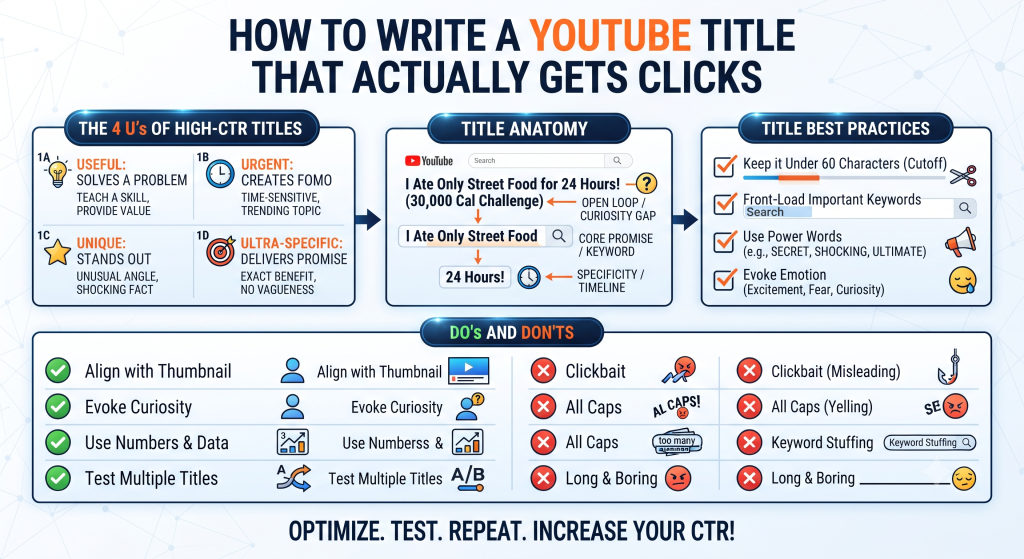
Here’s an uncomfortable truth about YouTube: your video can be genuinely great and still get almost no views, purely because the title didn’t make anyone want to click. Meanwhile, a mediocre video with a sharp title can rack up views it arguably doesn’t deserve.
That’s not fair, but it’s how the platform works. YouTube doesn’t know your video is good until people click it. The title is the single biggest lever you have over whether that first click happens at all.
And yet most creators write titles almost as an afterthought — something like “My Trip to Japan Vlog #3” — after spending hours editing the actual video. That’s backwards. The title deserves as much thought as the thumbnail, arguably more.
Why Most Titles Fail
Weak titles tend to fall into one of three traps:
Too vague. “Cooking Video” or “My Morning Routine” tells a viewer nothing about what’s actually different or interesting about this particular video versus the thousand others with the same generic name.
Too literal, with zero curiosity. “How I Edit My Videos” is fine, but it doesn’t promise anything specific. Compare that to “The Editing Mistake That Was Killing My Retention” — same rough topic, one version makes you want to know more.
Keyword-stuffed and robotic. Titles like “Best iPhone 16 Review 2026 iPhone 16 Camera Test Unboxing” read like someone typing every possible search term into one string. It might technically contain the right keywords, but it looks spammy and actively hurts click-through rate, because it doesn’t read like something a human would actually want to watch.
The best titles do two things at once: they contain a keyword someone is actually searching for, and they create a specific reason to click right now.
What Makes a Title Actually Work
Specificity beats cleverness. “I Tried Intermittent Fasting for 30 Days” beats “My Health Journey” every time, because it tells you exactly what you’re getting and for how long.
A hint of tension or stakes helps. “The $50 Camera That Beat My $2,000 Setup” works because there’s a built-in question — how is that even possible? — that the viewer wants answered.
Numbers and specifics ground the promise. “5 Mistakes” beats “Mistakes.” “In 10 Minutes” beats “Quickly.” Concrete details signal that the video actually delivers something, rather than being vague filler.
The keyword still has to be in there naturally. A title can be creative and still contain the actual search term people are typing. “The Editing Mistake That Was Killing My Retention” still reads naturally if the underlying keyword is “video editing mistakes,” because the phrase fits without feeling forced.
How the Title Generator Actually Helps
Writing five different title options in five different styles, for every single video, takes real time — time most creators don’t have when they’re also filming, editing, and managing everything else around a channel.
Our free Title & Description Generator handles that first draft work for you. You give it your topic and a rough sense of what the video covers, and it studies patterns from what’s currently working in similar searches, then generates several title options in different styles — direct and keyword-forward, curiosity-driven, number-based, and a more casual conversational option.
You’re not meant to just take the first suggestion and paste it in blindly. Think of it as a fast first draft that gets you unstuck, which you then tweak to match your voice and the specific video. It’s genuinely faster to edit a strong starting option than to stare at a blank title field trying to think of one from scratch.
A Practical Before-and-After
Say your video covers a beginner’s guide to sourdough baking. A generic first-draft title might be: “Sourdough Bread Tutorial.”
Running the same topic through a title-generation process typically surfaces options closer to:
- “Why Your Sourdough Keeps Coming Out Dense (And How to Fix It)”
- “Sourdough for Complete Beginners: The 5 Steps I Wish I Knew First”
- “I Followed Every Sourdough ‘Rule’ — Here’s What Actually Mattered”
Each one still centers on the core topic and keyword, but each creates a specific reason to click that “Sourdough Bread Tutorial” simply doesn’t.
Titles Still Need to Match the Video
One important guardrail: a title’s whole job is to accurately promise what’s inside, not just to maximize clicks. If your title implies a dramatic reveal or specific result that the video doesn’t actually deliver, viewers notice fast — retention drops, and YouTube reads that as a signal the video isn’t satisfying, which hurts you in recommendations over time.
The goal isn’t clickbait. It’s writing the most honest, specific, curiosity-driving version of what your video is actually about. A title generator can give you strong starting phrasing, but you’re still the only one who knows whether a given title accurately represents your content — that judgment call stays with you.
Give It a Try
If you’ve got a video sitting in your queue with a placeholder title you’re not excited about, that’s the perfect test case. Drop your topic into the Title & Description Generator, look through a few style variations, and see which one you’d actually click on if you saw it in your own feed. That gut check is usually all you need to pick the right one.